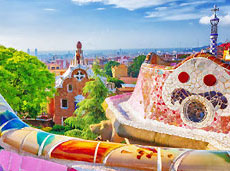
Barcelona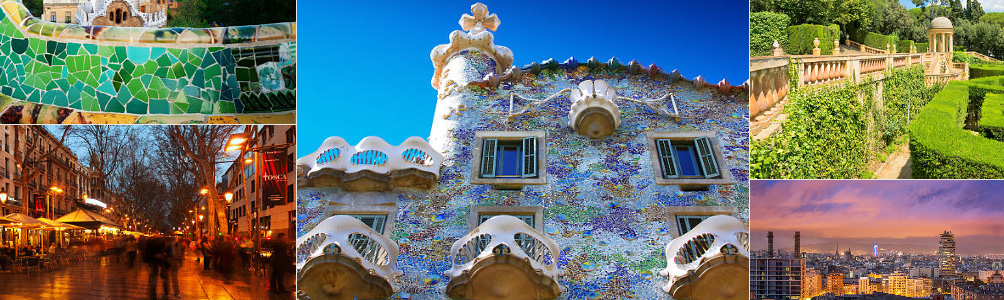
Things to do in Barcelona
Barcelona is the capital of Catalonia and the second largest city in Spain (1,616,000 inhabitants, 3,186,000 in its metropolitan area). Cosmopolitan due to its history and vocation, it offers visitors a wide variety of offers that combine the most innovative proposals with a tradition rooted in its millenary origins. Discover what to see in Barcelona for free as the bunkers of the Carmel.
Sagrada Familia
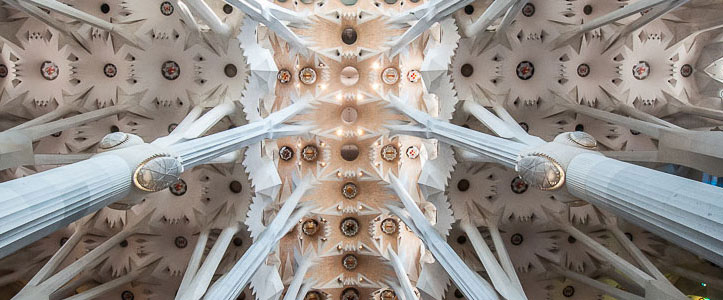
This amazing cathedral is still a work in progress and is undoubtedly one of Gaudí's greatest monuments. He began working on the project in 1884, lived and worked on the building while the project was underway. Gaudí supervised the construction of the apse, crypt and Nativity façade on the outside of this huge building.
After his death in 1926, the rest of the construction has been supervised by his colleagues. The work is expected to be completed in 2026. The Holy Family is a World Heritage Site and has recently been consecrated as a minor basilica by Pope Benedict XVI, despite being unfinished.
Eight of the eighteen enormous towers today have been built, corresponding to eight of the twelve planned apostles. The other six towers will mean four evangelists, the Virgin Mary and Jesus Christ. The Sagrada Familia is located in Plaça de la Sagrada Família, Mallorca, 401, 08013 Barcelona.
There are subway stations nearby and also many companies run bus trips to see this impressive building. It fills up quickly, especially in the high summer season to arrive early and wait to have to queue up.
Casa Batlló
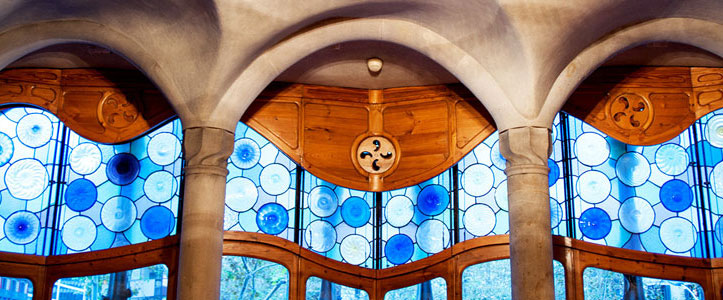
Casa Batlló is located in the centre of Barcelona, at number 43 of Barcelona's most glamorous avenue for its international luxury brand shops. The Paseo de Gracia.
It is a remodelling carried out between 1904 and 1906 of an existing building. The Casa Batlló was commissioned by the textile businessman Josep Batlló y Casanovas to the architect Antoni Gaudí.
Gaudí concentrated his reform in the facade, the stately plant, the patios and the roof. The fifth floor was erected to house the service and laundry rooms.
As was usual at that time, the upper floors of the stately homes were rented to ordinary people as they lacked an elevator.
There are many hotels near Casa Batlló, of different categories. From the rooms of several hotels on the Paseo de Gracia you can even see the beautiful façade of Casa Batlló.
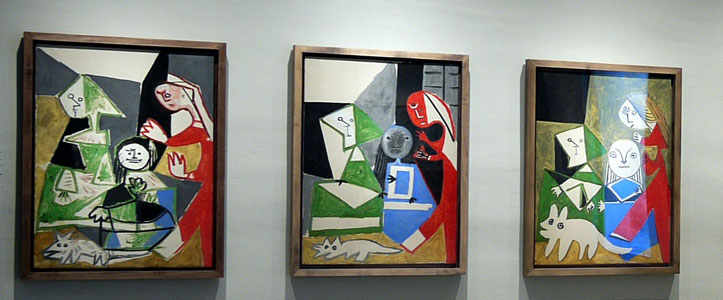
Museum Picasso
Park Güell
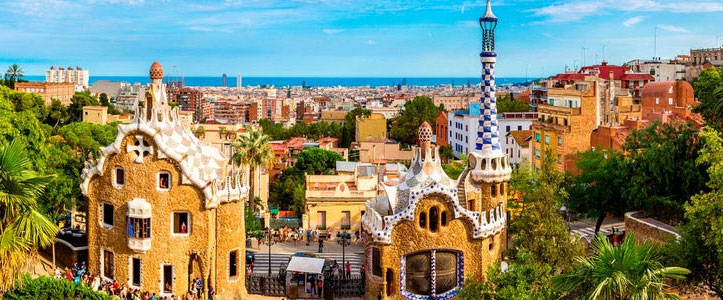
Parc Güell Barcelona is a very popular urban park built by Gaudí, originally as a park for the aristocracy of Barcelona, commissioned by Don Esebio Güell.
The park is situated on a large hill (be prepared for a steep walk, if you plan to visit here) and is surrounded by a wall, with two entry cottages. There are two houses in the park, one is now the Gaudí Museum, where Gaudí lived since 1906.
At the entrance to the park is the famous dragon statue located in the center of flight of steps. Many tourists stop to have a photo taken here, as it is also the main entrance to the park and is located near the Museum. The park has a magnificent view over the city of Barcelona overlooking its location to the top of the hill where the park was built and which is worth visiting.
Gaudí created many projects and buildings of astonishment throughout Barcelona and made a mark on the architecture and buildings barcelona there. Although the Sagrada Familia and Parc Güell are perhaps two of the most popular pieces of his work in Barcelona, there are many more attractions to choose from around the city. Take the time to visit these incredible architectural pieces when you visit Barcelona.
Iberian vestiges, Roman ruins, Gothic and Romanesque monuments and Baroque and Neoclassical palaces contrast sharply with the gridded streets of the Eixample, the density of urban traffic and the modernity conveyed by a city full of natural attractions (the mountains of Tibidabo and Montjuïc, especially if you go with children do not miss what to see in Barcelona with children) and supernatural: Gaudí's architectural feats, with the Sagrada Familia at the front, are the best presentation card of a city of great international projection.
Divided into ten districts, Barcelona has hosted two Universal Exhibitions (1888 and 1929) and the 1992 Olympic Games, events that have shaped it into a rich and diverse city, capable of captivating any visitor with its gastronomic and commercial offerings, with an overflowing cultural life and infinite leisure proposals. The variety of people and trends provides all kinds of possibilities that do not end in the most central and well-known neighbourhoods, but extend and branch out through all the points of an inimitable city.
If we have a few free days and we want to use them to visit new places, choosing Barcelona as a destination will always be a very wise decision, if you are looking for what to see in Barcelona in two days. The city, located between the Mediterranean Sea and the Sierra de Collserola, offers the visitor a range of possibilities so varied that surely will not disappoint anyone. Don't miss what to see in Barcelona and its surroundings.
La Pedrera
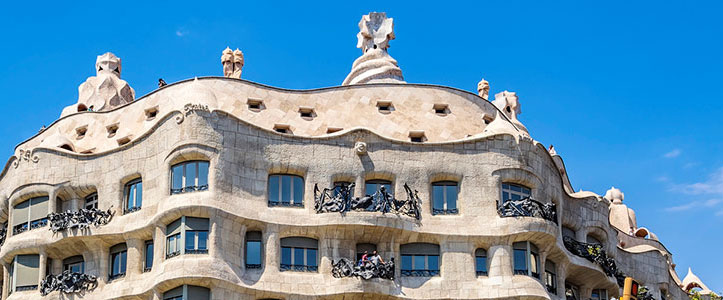
Casa Milá is located on the corner of Paseo de Gracia in Barcelona, at number 92. It is one of the best known works of the architect Antoni Gaudí.
It was built between 1906 and 1912 on behalf of the textile industrialist Pere Milà i Camps.
At the time it generated a lot of debate by completely breaking all the architectural standards of the city. Its sculpted and sinuous forms, its balconies and unusual windows for those years at the beginning of the 20th century earned it the nickname "La Pedrera" (the quarry).
The upper part of the building was expected to be topped by an enormous stone cross, due to the deep religious convictions of Antoni Gaudí and the Milá family, but the events of the "Tragic Week" of 1909 (in the middle of the construction of the building) made its installation be rejected.
Walking along the stairs and patios of this building is a magical experience. Antoni Gaudí works in the Casa Milá all the details in an exquisite and surprising way, even for visitors of our century, much more accustomed to intrepid buildings than the inhabitants of Barcelona in 1910.
Anyone who visits Barcelona cannot miss the walk on the roof of La Pedrera, its sculptural fireplaces and its undulating floor, added to its fabulous views of the city, make it an essential stop. From the roof of the Casa Milá you can even see Antoni Gaudí's masterpiece: The Temple of the Holy Family.
Under the roof of La Pedrera is the fabulous attic, where a small museum is located.
Antoni Gaudí surprises the visitor in every corner of the house, with decorations inspired by nature, typical of the Catalan architect and the modernist movement in general.
There are many hotels near the Casa Mila, of different categories. From the rooms of several hotels on the Paseo de Gracia you can even see the fabulous façade of La Pedrera.
La Pedrera
Las Ramblas
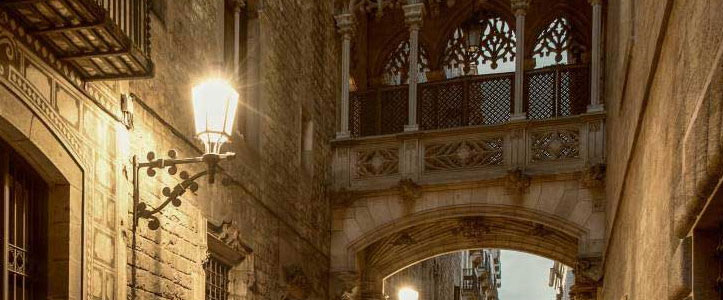
Gothic Quarter
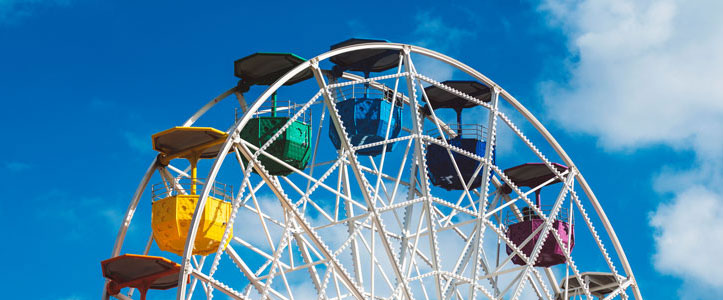
Tibidabo
We won't get to know Barcelona in a weekend, not even in a week. Therefore, we will have to plan our route well so that it is possible to us the maximum number of visits of which we could consider indispensable.
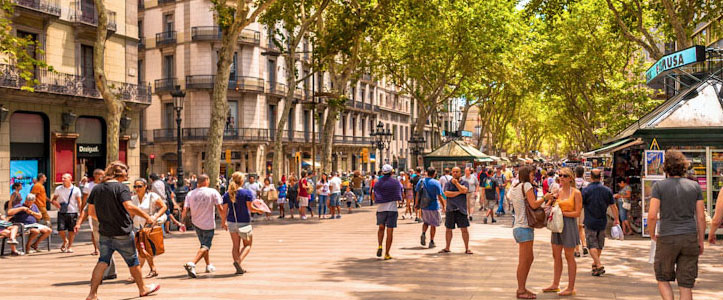
One of them, of course, is the Ramblas. No one can visit Barcelona and not take a stroll through this picturesque promenade, entering the human tide full of varied characters who walk up and down, often without a fixed destination. Walking along the Ramblas we smell the fragrant aroma of the flowers of the stops that are installed on either side of them, while we hear the call of their florists and their pretension that we buy them a rose or a beautiful bouquet of violets. We will also be able to contemplate their stops of small animals, their mimes that do not speak but express much, the talented but unlucky street painters who make beautiful drawings on the ground that the water will not take long to erase, or those who insist on guessing our future, perhaps the one we do not want to know.
Montjuic
The mountain of Montjuïch, also called the magic mountain, is a small mountain that dominates the centre of the city of Barcelona. Its thousands of nooks and crannies hide a multitude of tourist attractions that the visitor cannot miss.
The museums Fundació Miro and MNAC, the National Art Museum of Catalonia that houses a unique collection of Gothic and Romanesque art.
The Olympic Ring was the centre of the 1992 Barcelona Olympics. Here you will find the Lluís Companys Olympic Stadium, the Palau Sant Jordi, the Picornell Swimming Pools. Most of the city's major concerts take place on these stages.
The Castle of Montjuïch is a military building located in the highest part of the mountain, and dominates the port and the center of the city. It can be reached by a panoramic cable car.
On one of the slopes of the castle is a charming lighthouse, which once served as an orientation for the city's sailors. It is still in operation today, illuminating the night of Barcelona's coastline.
Also on the slope of Montjuïch there is a singular park of Cactus, the Gardens of Mossèn Costa and Llobera with more than 800 species of Cactus.
Descending from the Castle towards the centre of Barcelona, the path is made very pleasant by the succession of terraces overlooking the city and the port, known as the Mirador del Alcalde (Mayor's Viewpoint).
In the middle of all this variety of charming places is the Hotel Miramar, an oasis of luxury and tranquillity a few minutes from the city center, which as its name indicates enjoys unbeatable views of the port and the sea.
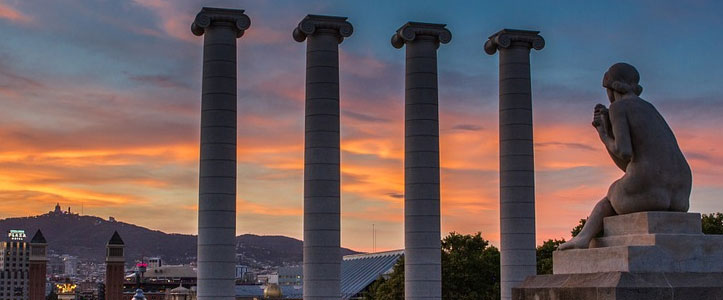
The fair of Barcelona is located in the skirts of Montjuich, in the majestic surroundings of the avenue Maria Cristina, the Palau Nacional that houses the MNAC and the tourist luminous sources, obligatory stop for any visitor of Barcelona.
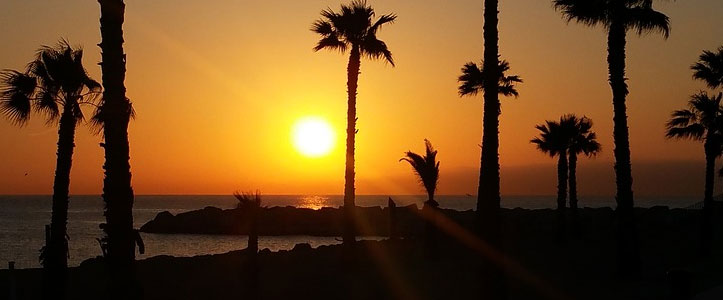
Of the largest tourist cities in the northern hemisphere, Barcelona is the only one with warm, holiday beaches.
The Barceloneta is the seafaring district of the city. Formerly it was the place in Barcelona where fishermen lived. Nowadays it is a very lively neighbourhood, full of restaurants where you can eat the best fish and seafood in the city. The specialty of most restaurants in Barceloneta is the rice paella, also the fideuà and rice broths.
This district is located on a land ledge that penetrates the sea. On the one hand there is the marina of Barcelona and on the other a long promenade and lively beaches.
Along the beach there are typical beach bars where you can refresh yourself during the day and have drinks at night.
The main characteristic of this district are its typical narrow streets and the animation at all hours.
The Barceloneta
Vila olímpica
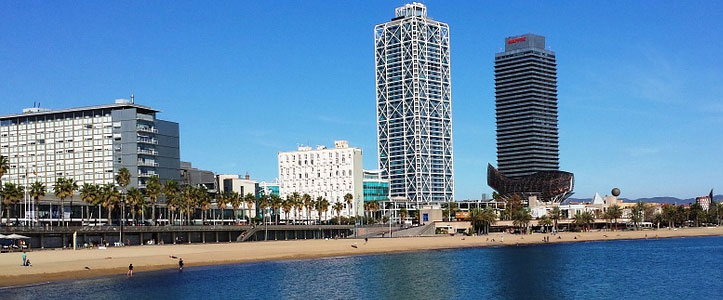
We should also not miss the old port of the city, for its beautiful Gothic quarter that takes us back to past times, its beach of Barceloneta, where we can still have a few fish in some typical local fishermen, its Park of Ciutadella in which we can even take a boat ride in its attractive lake.
There are so many interesting places to visit that we can not relate them all, still leaving many important as the Park Güell, Tibidabo, Montjuic mountain, the Park of Labyrinth, the Spanish People or the Olympic Port.
Mercado de la BoqueríaThe origins of the market date back to the 12th century, when sellers gathered next to the walls to sell their goods there. Nowadays, this market has approximately 300 stalls dedicated to different areas of gastronomy.
Boqueria Market
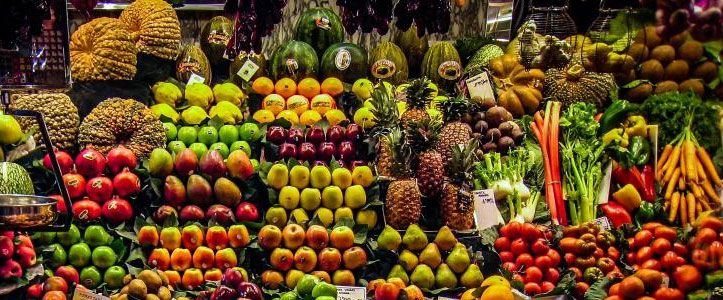
Don't miss the shops dedicated to products of Catalan gastronomy, such as butifarra and calçots. For lovers of good food, nothing like the local gourmet, where you get top quality Russian caviar and French wines.
Finally, the Bar Pinotxo, an emblem of the market, where you can taste delicious tapas and a magnificent cod, the specialty of the house.
The Born neighbourhood is the most avant-garde neighbourhood in the city.Old commercial district of post-medieval Barcelona. The old warehouses of weaving and overseas merchandise have been reformed in the most audacious way to locate restaurants and shops of the most varied styles but with a common denominator: The avant-garde and cosmopolitanism. Restaurants with all the flavours of the world, clothing shops, artists' workshops.
The people of Barcelona come to the Born during the day to look for clothes and other unique products, and at night for dinner or drinks.
The Born district is part of the historic centre of Barcelona, and is located right next to the Gothic quarter, separated by Via Laietana.
In the heart of the Born district we find one of the jewels of Barcelona. The church of Santa Maria del Mar, best known for the Catadral del Mar, the title of the best-selling novel by the Barcelona writer Ildefonso Falcones.
As the novel tells, the spectacular church was promoted by the fishermen's guilds and workers of the nearby port. The stones were brought from the nearby quarry on Montjuïch mountain, three kilometres from the temple.
Its Gothic style perfectly reflects the medieval atmosphere that reigns throughout the centre of Barcelona.
Joined to the church by a lively walk full of trees, we find the Born market, former main food market of the city that is currently being renovated to house a museum. The initial intention of Barcelona City Council was to install a library there, but the works discovered the remains of a network of streets and houses of the old Barcelona. The building, a classic structure of wrought iron and wood will now be dedicated to sheltering and showing visitors these archaeological remains.
Casa CalvetBeyond the world-famous architectural works of Antoni Gaudí, we find other lesser-known but equally brilliant works such as Casa Calvet.
Commissioned by a textile entrepreneur, the offices, offices and boardrooms on the lower floors have now been converted into a famed restaurant.
Other lesser-known works by Antoni Gaudi are the Palau Güell or the Crypt of Colonia Güell.
Barcelona offers many other modernist buildings by other brilliant architects such as Lluís Domenech y Muntaner or Josep Puig y Cadafalch.
All these modernist buildings, distributed mainly in the Eixample district (enlargement) were built in the golden age of Barcelona at the beginning of the twentieth century.
The Eixample was an ambitious project to enlarge the old walled city of Barcelona, and was built at the beginning of the 20th century following the project of the engineer Ildefonso Cerdá.
Its rectilinear framework, its wide streets and its blocks with chamfered corners to improve the visibility of vehicles, are the hallmark of this urban project.
In Barcelona at the beginning of the 20th century, the most prosperous sector of the country were the textile industries located mainly on the outskirts of the city, in industrial colonies located next to the rivers that provided them with water and electricity.
The rich businessmen of the textile sector invested their fortunes in building opulent palaces in the capital, mainly in the new district of the Eixample, much more airy and modern than the historic centre of Barcelona.