Barcelona
Barcelona 92
On July 25, 1992, the Barcelona 1992 Olympic Games began in Spain and concluded on August 9. A total of 169 countries participated, with 9,356 athletes.
With Pascual Maragall’s election as mayor in 1982, the project gained momentum, leading to Barcelona’s selection in 1986 by the International Olympic Committee in Lausanne, Switzerland. Spain, the host country of the Games, won thirteen gold medals at Barcelona ’92.
In the wake of the 1992 Barcelona Olympics, the city improved its infrastructure, such as El Prat Airport; the Olympic Stadium and the Palau Sant Jordi were built; and many parts of the city, such as the Olympic Village, were modernized.
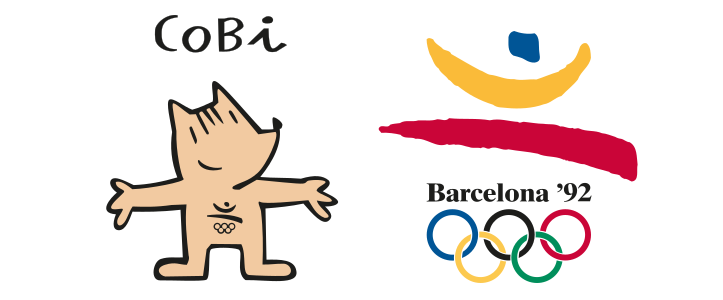
The mascot designed by Javier Mariscal for Barcelona ’92, Cobi, broke with the more traditional ways of representing an Olympic Games mascot. In this case, it depicted a dog in a cubist style; at first, it was not very well received by the public, but as the event drew nearer, it began to grow increasingly popular with the public.
One of the most frequently played songs during the event was the album “Barcelona,” which became the official anthem of the 1992 Barcelona Olympics. Composed between 1987 and 1988, it was performed by Freddie Mercury, lead singer of Queen, and opera singer Montserrat Caballé, with Mike Moran on piano and conducting the orchestra.
We continue to explore the Olympic legacy of Barcelona '92
In our previous article on the Olympic legacy left in the city of Barcelona, we focused extensively on highlighting everything related to the Olympic Village and the Olympic Port—areas that were once somewhat neglected but have since become some of the city’s most attractive destinations.
Today we will focus on the Olympic Ring located on Montjuïc Mountain, where most of the sports facilities for the 1992 Barcelona Olympic Games were situated.
During the summer of 1992, Montjuïc Mountain became a Mount Olympus where various sports disciplines converged. The Montjuïc Stadium served as the venue for the opening and closing ceremonies of the Olympic Games; the Olympic flame remained there, and the premier track and field events were held there. This stadium, rarely used in the city, was completely remodeled while retaining its main structure.
Next to the Olympic Stadium, what was arguably the icon of the Games was built: the Sant Jordi Pavilion. A multi-purpose sports arena capable of holding 17,000 people and featuring an impressive exterior structure. The building was designed by Japanese architect Kawaguchi, who impressed the entire world with this magnificent structure. The Palau Sant Jordi, which today serves as a venue for various events and gatherings, was the site during the Olympic Games for sports such as artistic gymnastics, volleyball, and handball.
Palau Sant Jordi, a symbol of the 1992 Barcelona Olympics
Barcelona draws inspiration from both its own traditional architecture and structures built for special occasions, whether those be world’s fairs or the 1992 Barcelona Olympics themselves. Today we’ll be discussing one of the buildings that has been preserved and is frequently used, which was constructed for the 1992 Barcelona Olympics. We’re referring to the Palau Sant Jordi.
In fact, some believe it is the finest structure built for the Olympics. The truth is that many projects were undertaken for the Games, and Montjuïc Mountain itself was adorned with splendid buildings. However, it is certainly true that the Palau Sant Jordi has a certain allure.
Its curves possess the elegance of discretion and the remarkable ability to blend into the surroundings like a tailor-made suit, both in relation to the other architectural elements that make up the “Olympic Ring” and to the contours and volumes of the mountain.
Recalling what was said earlier—that it is the best building constructed for the 1992 Barcelona Olympics—the complexity of the dome, which was built on the ground and had to be lifted with hydraulic jacks and installed in a complicated operation that lasted ten days, perhaps merits not the title of “best” but certainly that of “most labor-intensive” of the Olympic Games.
The building has a capacity of 17,000 spectators and was designed by the Japanese architect Arata Isozaki. Across from the Palau Sant Jordi, we can see a forest of strange artificial trees—with concrete trunks and flexible metal cables—that seem out of place in their surroundings. This “forest” was created by Aiko Miyawaki and is called “Utsurohi,” which means “change.”
In short, Olympic Barcelona has more than one landmark throughout the city, such as the Palau Sant Jordi itself or the Olympic Port. The Olympics provided the perfect excuse to reorganize and once again fill the city with iconic buildings—an opportunity Barcelona has successfully capitalized on, maintaining the utility of these sites and structures. This stands in contrast to many other cities, which struggle to find a purpose for iconic buildings that were used only once for a specific special occasion.