Barcelona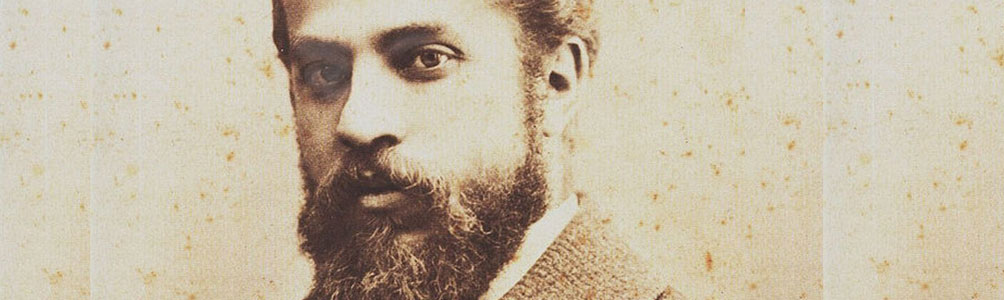
Antoni Gaudí
Architecture of innovation and wise tradition of Gaudí
The architecture of Antoni Gaudí (1852-1926), maximum representative of Catalan modernism and author of a work that has reached a wide international diffusion, is one of the main attractions of Barcelona. And not only because of the extraordinary temple of the Sagrada Familia, but also because of many other surprising creations in which geometry and volume are combined to form unusual combinations. Gaudí went far beyond orthodox modernism and developed a very personal style that was inspired by the observation of nature and encouraged the use of geometric forms such as the helicoid, the hyperboloid, the hyperbolic paraboloid and the conoid. In addition, he integrated into his architecture handcrafted elements such as glassware, ceramics, carpentry or iron forging, which give a very characteristic touch to his works and turn them into a perfect mixture of tradition and innovation.
The characteristics of his work deeply impressed the Catalan industrialist Eusebi Güell, starting a fruitful patronage that would lead to some of the most outstanding creations of the Reus architect: the Güell wineries, the Güell Palace and, of course, the Güell Park. But the most decisive moment in his career came in 1883, when he agreed to take charge of the works of the expiatory temple of the Sagrada Familia. After substantially modifying the initial project, he turned it into his masterpiece, which is admired all over the world and has become one of the greatest symbols of Barcelona. From 1915 Gaudí dedicated himself body and soul to this project.
Güell Palace
Count Güell commissioned Gaudí to build his family house on Nou de la Rambla Street in Barcelona. Gaudí designed a monumental entrance with magnificent doors with parabolic arches and openwork wrought iron grilles, decorating the interior of the palace with a sumptuous decoration of Mudejar style, where the ceilings with wooden and iron coffered ceilings stand out.
Las Teresinas school
Gaudí fulfilled the will of the order to reflect austerity in the building, in fulfillment of the vow of poverty; following the indications of the nuns he designed a sober building, made of brick on the outside, and with some brick elements inside. He also incorporated wrought iron grilles into the façade, one of his favourite materials, and crowned it with a set of battlements that suggest a castle.
Casa Calvet
On behalf of the company name Hijos de Pedro Mártir Calvet, Gaudí built the Casa Calvet on Caspe Street in Barcelona. The façade is made of silería stone adorned with wrought iron balconies and crowned by two pediments, crowned with crosses of wrought iron. In this project Gaudí opted for Baroque with the use of Solomonic columns, decoration with floral themes and the project of a roof with waterfall and flowerpots of rococo air.
Park Güell
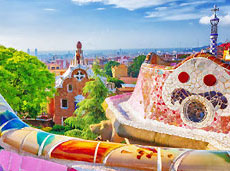
Its main project at the beginning of the 20th century was a residential development in the style of British garden towns. Although the idea was unsuccessful, Gaudí deployed many of the innovative structural solutions that culminated in the Sagrada Familia. Güell Park is located in the Carmel district, an abrupt spot with steep slopes that Gaudí negotiated with a system of viaducts integrated into the terrain.
Casa Batlló
One of his most emblematic works. It conserved the rectangular shape of the balconies of the original building, with iron railings in the shape of a mask, and gave the rest of the façade an undulating shape in an ascending direction. He also clad the façade with ceramic pieces of glass of various colours and covered the inner courtyard with a glass skylight supported by an iron structure in the shape of a double T, supported by a series of catenary arches.
Casa Milà
Better known as La Pedrera, he conceived it around two large courtyards of curvilinear form, with a structure of pillars of stone, brick and cast iron, and lattices of iron beams. Its entire façade is made of limestone, except for the upper part which is covered with white tiles, evoking a snowy mountain.
Sagrada Familia
His masterpiece, a synthesis of all his architectural evolution. After creating the crypt and apse in neo-Gothic style, he conceived the rest of the temple in an organic style, imitating the forms of nature. The interior had to resemble a forest, with a set of inclined arborescent columns, helical in shape, creating a structure that was both simple and resistant. This great work has a Latin cross floor plan, five central naves and a transept with three naves and an apse with seven chapels. It has three façades dedicated to the Nativity, Passion and Glory of Jesus and when completed it will have eighteen towers, two sacristies next to the apse and three large chapels. It is by far the most visited monument in Barcelona.